

Ireland Before the Celts, Part 1

Updated: May 7

A mystical presence permeates Ireland’s atmosphere, as palpable as the sprinkles of moisture in an otherworldly mist. Shadows and whispers speak of the people who lived, loved, and fought on the island thousands of years ago. They left their mark on its landscape: stone circles, dolmens, burial mounds, and passage tombs. Archeological findings indicate they resided here as far back as the Neolithic period (4000-2500 BCE). They prepared the land and paved the way for the island’s current residents. But who were these ancient inhabitants? What were they like? Science, scholarship, myths, and legends paint an impressionist’s portrait from which one thing is clear. They weren’t Celts.
The first Celts arrived on the island now called Ireland more than a thousand years ago. The exact time of their arrival is in debate. In fact, scholars give a timeline that varies from 100 BCE to 1000 BCE! When the Celts landed, they found the island occupied by two to three other groups of peoples. According to sources, the Celts were the third—or possibly the sixth—wave of immigrants to the island. They are considered the final “invaders,” and the ancestors of the modern-day Gaelic Irish.
But it is the Celts themselves who preserved the memory of the earlier inhabitants through mythology and the Lebor Gabála Érenn, a mythic history known in English as The Book of Invasions. So, follow me back to pre-Celtic Ireland and meet these other settlers whose presence lingers on the island to this day.
You Got Proof?
Proof is a strong word in regards to who these ancient people were. However, evidence of their existence can be seen throughout the Emerald Isle. Scattered across Ireland’s landscape are monuments that give testimony that these people aren’t myths. They not only existed, they lived, worked, worshipped, and died on Irish soil. These weren’t itinerant hunter / gathers passing through. They built communities and left an architectural legacy that provides clues to their complex societies. Archaeology has discovered, through carbon dating, that the people who built these structures lived on the island during the Neolithic period (which spans from 10,000 to 2,000 B.C.E.).
Because of its ancient origin and mysterious aura, Stonehenge, in southeastern England, attracts millions of visitors each year. Yet, Ireland’s Newgrange, a chambered burial tomb aligned so it fills with sunlight at the summer solstice, is older than the English stone circle. It is older as well, archaeologists say, than the Great Pyramids of Egypt. So, too, is Hillfort. Located in Co. Wicklow, Ireland, is considered “the largest nucleated settlement…in prehistoric Ireland and Britain” (per Archaeological News). In other words, it was a settled town. Hillfort is part of a larger structure, the Brusselstown Ring, which dates to the early Neolithic period and shows activity up to the Bronze Age. There are numerous other examples of Neolithic buildings and monuments across Ireland. This is the scientific evidence of Stone Age settlers on the island.
The details of just exactly who they were is fascinating, but a bit less objective fact. The major source of knowledge about these ancient people is the Celtic authored Book of Invasions (Lebor Gabála Érenn). Created in the 12th century, the Book of Invasions contains a collection of narratives from Irish oral tradition and, perhaps, other pre-existing sources. The author is anonymous, but scholars believe the person (or persons) to be Celtic and Christian. Until the 19th century, the book was accepted as authentic history.
Scholars now believe it is a pseudo-history or a creation myth produced with an agenda in mind. They claim its author or authors wanted to present a history of the Irish people that dates all the way back to before the Flood (you know—the one with Noah and the animals). Thus, it starts with the anti-diluvian arrival of Cessair and her people to the island.
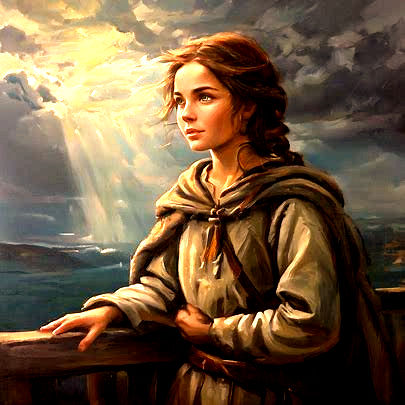
She, according to the book, is a daughter of Noah’s son, Bith (who is not mentioned in the Bible). The book tells of her life and the fate of her people, then continues with the story of other groups of people who invaded and ultimately settled on the island. The book ends with the story of the final settlers (in its narrative), the Celtic Milesians.
But the book is not the sole source of knowledge of these groups. The inhabitants—the Formorians, the Fir Bolg, the Tuatha de Danann, and the Milesians are central characters in Irish mythology (which pre-dates the book) and folklore. Part 2 will focus on who they were, how they interacted, and what became of them. I’ll also include stories about key mythic characters, such as the one-eyed Formorian, Balor, who could kill with a look, and his grandson, Lugh, a member of the Tuatha de Danann, who became Irish mythology’s golden boy.
This part 1 post will focus on the earlier settlers, who had some interesting—and sometimes strange—stories themselves.
Cessair, Three Men, and a Whole Lot of Women
According to the Book of Invasions, Cessair, whom I mentioned above, and her people were the first people to settle on the island that would become known as Ireland. Cessair knew it as Innis Fáil (Island of Fate or Destiny), and she knew it was uninhabited. Aware the flood was coming (her grandfather was Noah), and reasoning that the uninhabited island was free from the taint of sin, so the flood wouldn’t harm it, she decided to sail there.
Cessair took with her a group of fifty women, her father, and two other men. The journey lasted seven years. According to The Annals of the Four Masters, Cessair and her people reached the island in 2361 B.C.E. Then they set up a strange arrangement. The women were put into three groups, one group for each of the men. Apparently, this seemed a good plan to repopulate the world. But it failed.
Her father, unable to handle the stress of satisfying all his wives, soon died. The other man, Ladra, died shortly thereafter. That left the third man, Fintan, Cessair’s chosen husband, with fifty wives. He ran away to a cave in the hills, leaving Cessair to die of a broken heart.
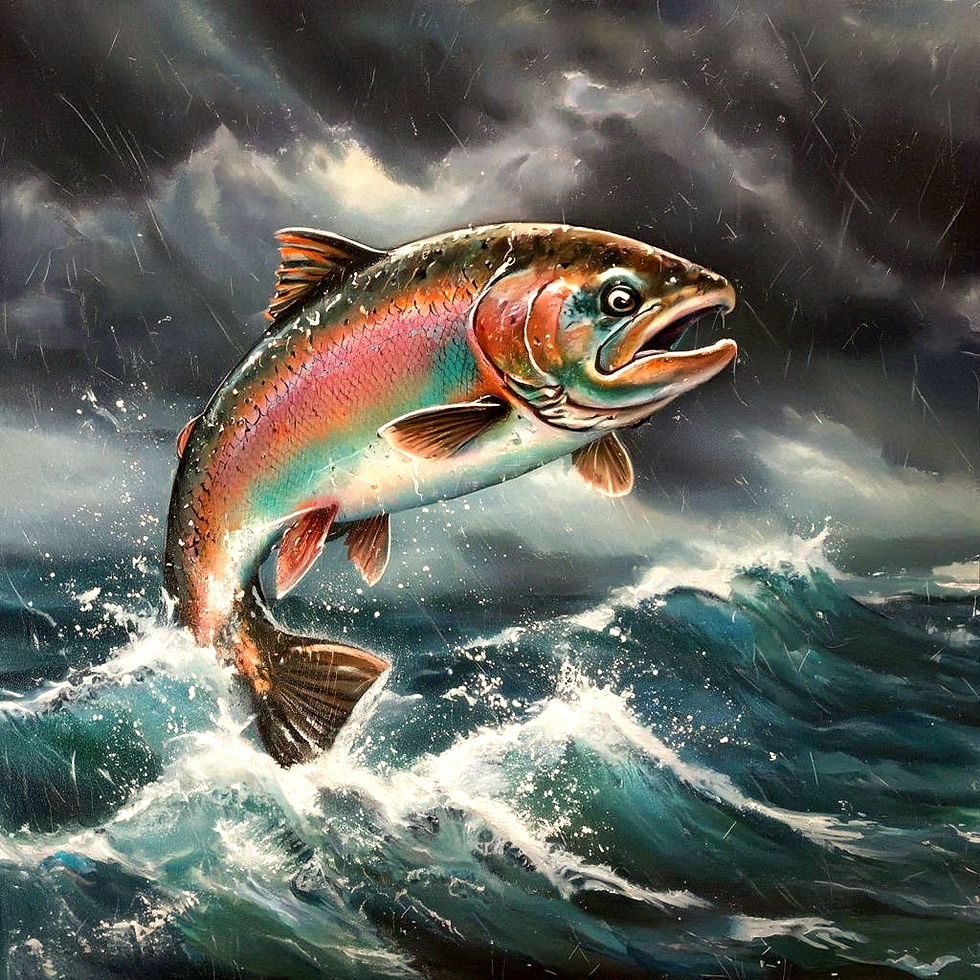
When the flood came, he transformed into a salmon, swimming away and living for more than 5,000 years. But the women all died. Maybe. Some sources say one woman, Banba, survived and gave birth to the supernatural Formorians (who are coming up later in the post).
There is an alternate version of the story. With no mention of Cessair, it tells of three sisters: Banba, Fodla, and Éiru, a trio of goddesses, who bring the fifty women and three men to the island. Ultimately, Éiru gave her name to the island—Éire.
Dividing the Island: The Partholonians
The second group of settlers is the Partholónians. They contributed in important ways to Ireland’s development. They cleared land to make way for farming. Also, they built monuments. Perhaps the most lasting legacy comes from Partholon, the leader. He divided the island into four parts. To this day, Ireland traditionally has four provinces.
This group isn’t just mentioned in the Book of Invasions. The Historia Brittonum (compiled earlier than the Lebor Gabála Érenn) speaks of them as well.
Sadly, the Partholónians all died in a single week from a plague.
The Nemedians: An Ancestral Bridge
Although they are not often talked about, the next group of invader / settlers provide a connection between Cessair and the later, better-known peoples of ancient Ireland.
Nemed and his followers. who came about thirty years after the Partholónians died out, form a kind of connection between the early settlers and the later invaders. Like Cessair and her father, Bith, he is a descendant of Noah—by about ten generations. Scholars also believe the Nemedians were the ancestors of the Fir Bolg and the Tuatha de Danann, who settled in Ireland about 200 years later.
Some sources date the arrival of the Nemedians at 2350 B.C.E. Others say it was around 1731 B.C.E. Like the Partholónians, they left their mark on the landscape. The Nemedians are said to have cleared twelve plains to make way for settlements and agriculture. They built two forts, one in Antrim and the other in Armagh (both located in the north of the island). Also, four lakes are said to have sprung up during their residency.
Now, all of that sounds suspiciously similar to the advances the Partholónians are credited with, leading me to question if this similarity stems from different versions of the same oral history or whether the Nemedians simply continued the same type of social and communal progress. After all, Ireland now has 12,000 lakes and numerous Neolithic forts, so it’s possible both peoples contributed.
There is one major conflicting detail that comes up in the story of the Nemedians. The narrative says that the island remained uninhabited from the time of the Partholónians mass demise. However, during the same narrative, the Nemedians find themselves in a fight for survival because of terror attacks and oppression from the Formorians, the supernatural descendants of Banba and Fintan.
Some scholars contend that the monstrous Formorians symbolize natural destructive forces, such as storms, drought, harsh winters, and so forth, personified by the narrators. Okay. That’s a scholarly take. But I’m a folklorist. I recommend suspending disbelief and accepting the story as told. It’s more fun that way. Besides, what I’m about to tell you will not really make sense if the Nemedians are fighting nothing more than harsh natural conditions.
The Formorians bully the Nemedians into paying an annual tribute, and it’s a costly one. Each Samhain (October 31 / November 1), Nemed’s people must give the supernatural monsters corn, milk, and two-thirds of their children! Again, scholarly reason says this represents a sacrifice offered to the gods at the start of winter. Maybe, but then how do you explain that the Nemedians finally rise up against the tyrants and go to battle against them four times?
The first three times, Nemed’s people triumph. Then he and three thousand Nemedians die of the plague.

But the people plan and carry out a massive fourth battle, attacking the Formorian stronghold, Conand’s Tower. Initially, they have success, defeating Conand himself. But another Formorian leader, Morc, counterattacks. The result is devastating. Almost all of Nemed’s people are killed. Only thirty survive.
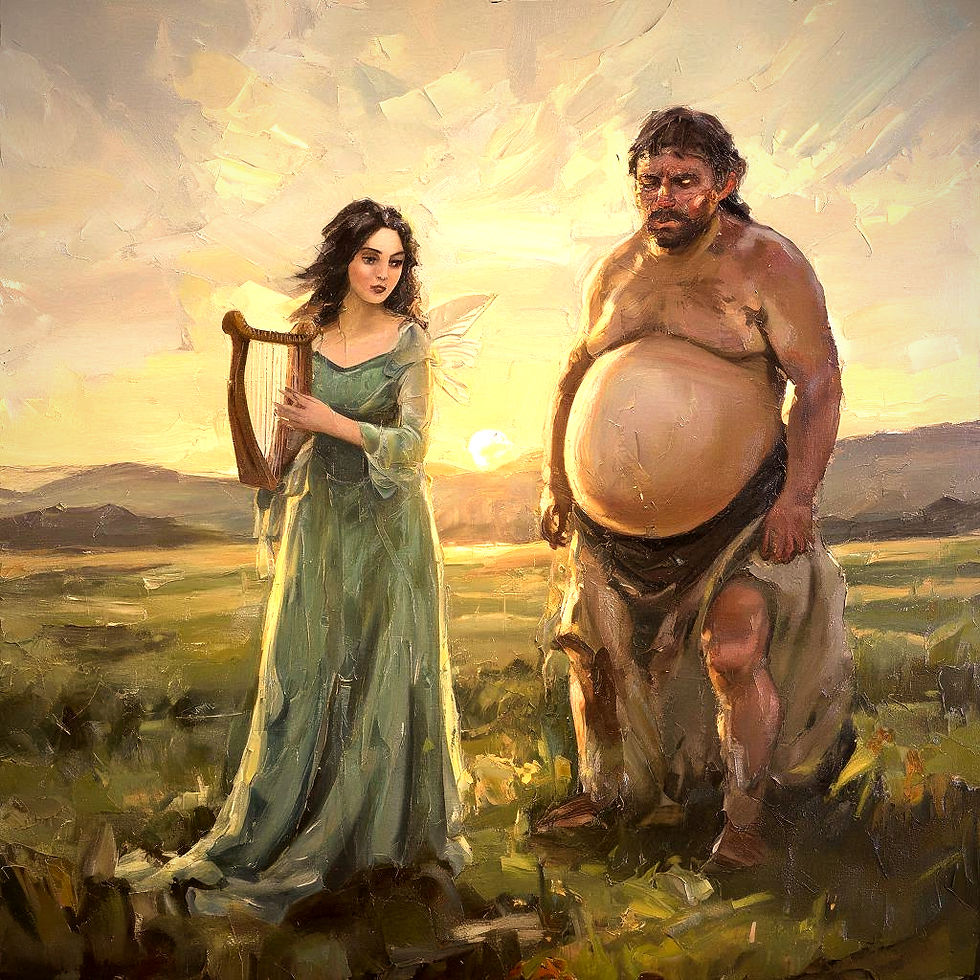
The survivors abandon the island, ultimately ending up in three different places. One group goes to the northern part of a nearby large island (which will become known as Britain). They become the ancestors of all the Britons. Another group goes to Greece, and the third goes “north.” About two hundred years later, the descendants of the last two groups will return to Ireland. Those who went to Greece (and had a really bad time there) became known as the Fir Bolg (or “Belly Men”). The northern group returns as the Tuatha de Danann, a supernatural race who figure prominently in Irish mythology and, ultimately, become the ancestors of the faeries.
The Formorians remain and will give the Tuatha de Danann a lot of grief. But the de Danann are a magical race who can more than stand up to the giant foes.
Finally, a group of Gaelic Celts, the Milesians, arrives on the island, and a battle for supremacy ensues.
Part 2 of “Ireland Before the Celts” explores these last three groups of invaders, their conflicts, interactions, and fates. These are the major groups immortalized in ancient Irish history, myth, and folklore. The Mileseans are the ancestors of the modern Gaelic Irish. But that doesn’t mean they’re the only ones who remained. Join me on Friday, May 15th to explore not only what happened to these peoples, but to get to know a few of the major characters of this epic drama. Their memory still fills the Irish mists.
Thanks for reading! I hope you enjoyed this post and any of my others you check out. Please LIKE and SHARE. To SUBSCRIBE for FREE, just click on the “Sign Up” button in the upper right of the page.
All artwork for this post (except for the Ukrainian flag and the GIF) by Christine Dorman via Bing Image Creator.
Go raibh maith agat! Slain go foil!\
Looking for a guide along your writing journey? Click here for a description of my writing and tutoring services. Questions? Just click here to contact me.


Comments