

Rhiannon’s Strange Transformation: A Welsh Mythology Mystery

Updated: Mar 4

She rules her life like a fine skylark…
Once in a million years, a lady like her rises.
“Oh, Rhiannon,” you cry,
But your life knows no answer.
Baby, your life knows no answer.
“Rhiannon,” Stevie Nicks, 1975
“This is a story about an old Welsh witch,” Stevie Nicks used to say to introduce her smash Fleetwood Mac song. According to Nicks, she had been inspired by the name of a character in the novel Triad by Mary Leader. It wasn’t until two years after writing the song that she read the myth of the Welsh enchantress/goddess, Rhiannon.
Strangely, Nicks’ lyrics fit the mythical queen. “She rules her life like a fine skylark” is a perfect description of the cool in-charge goddess Rhiannon is at the beginning of her story. Her lyric also includes the line “All your life, you’ve never seen a woman taken by the wind.” Towards the end of the myth, Rhiannon enters a dark tower. A whirlwind envelops the building and raises it up. Both it and Rhiannon vanish! What a dramatic exit for an enigmatic goddess.
While the apparently coincidental alignment between the myth and Nicks’ lyrics are intriguing, a more puzzling mystery is that this clever, resourceful enchantress abruptly transforms in the middle of her story. She becomes the meek, submissive good little wifey that the patriarchal, Christian church-controlled society of medieval Wales sees as a model of womanhood.

As an academic, I can accept that that is the explanation for her out-of-character behavior. Hers is an ancient tale kept alive through oral tradition then written down in the Middle Ages—with editorial changes. But, as a storyteller, I want to explore whether this drastic and temporary change in Rhiannon makes sense from a character and in-world perspective. Let’s find out together!
How to Catch a King Without (Apparently) Trying
At the start of her story, Rhiannon has a problem—and a plan for solving it.
Pwyll, the handsome young King of Dyfed, is riding with his hunting companions. Rhiannon appears in the distance, riding a white horse at a walking pace.
Captivated by her Otherworldly beauty, Pwyll urges his horse forward. After all, he’s a young man. And a king with the confidence to approach her.
Soon, though, he notices he’s not getting any closer. He spurs his horse to top speed. She remains at a distance despite slow-walking her horse.
Frustrated and baffled, Pwyll finally gives up and goes home. But he can’t get her out of his head. He has to meet her. So, he tries again the next day. And the next. Still, he is unable to catch up with her.
In exasperation, he calls out, “Will you please stop!”
Rhiannon halts her horse and waits. When he comes alongside her, she chides him, “Why didn’t you do that the first day? I would’ve stopped sooner, if you’d only asked.”
They chat. She is charming, witty, and comfortable to talk to. Pwyll is smitten. Then Rhiannon says something that shocks him. “I’ve decided to marry you.”

Now, in Rhiannon and Pwyll’s day, this is not the usual way of things. The man proposes, especially if he’s a king. But Pwyll is too delighted to care!
Then Rhiannon reveals there’s a slight complication.
Just Do One Little Thing for Me, Honey
Rhiannon’s father has arranged for her to marry Gwawl ap Clud, but she has neither the intention nor the will to do so. She tells Pwyll he has to do is marry her Gwawl does. Having never met this Gwawl guy, Pwyll happily agrees to take Rhiannon as his queen.
At the pre-nuptial feast, a nobleman dressed in silk brocade approaches Pwyll and begs that the king grant him one favor. In a jubilant mood, Pwyll says, “Anything. On my honor as king, I will grant your request.”
The nobleman smiles. “I am Gwawl ap Clud. I want Rhiannon, my betrothed.”
Oops! Pwyll not only has given away Rhiannon, he has to tell her.
Infuriated, she calls him a fool (and likely some stronger words). After collecting herself, she formulates another plan. For details, click the link to read my post, “Never Underestimate a Celtic Woman.”
Rhiannon’s plan works. She and Pwyll marry. For the first two years, they live together in near bliss. The only discordant note: in the second year of the marriage, the king’s advisors denounce Rhiannon as barren since she has yet to produce a child. They encourage the king to put her aside and try with a new queen. But Pwyll, who seems genuinely in love with Rhiannon, refuses.
Don’t Fall Asleep!
In the third year of their union, Rhiannon becomes pregnant and gives birth to a son and heir.
Exhausted, she falls asleep. Her handmaids settle down for a nap, too. When the maids awaken, they discover the baby has vanished. Fearing they’re going to be in BIG TROUBLE with the king and queen, the handmaids plot to shift the blame.
They kill a small animal and smear its blood on the still-sleeping Rhiannon. Then the duplicitous maids run to the king and his courtiers. They declare that the queen has murdered her newborn baby and eaten him!
How Can Rhiannon Get Out of This One?

Imagine what this is like for Rhiannon. She went to sleep in triumph, having delivered an heir to the kingdom.
But she awakes to a nightmare. Her baby is gone and she’s accused of infanticide and cannibalism.
Of course, Pwyll would never believe such an accusation of his beloved. Right?
Well….
Rhiannon Faces Pwyll
The king’s advisors and courtiers call again for Rhiannon to be put aside.
Pwyll doesn’t defend his queen, order the advisors out, or command the handmaids be beheaded for their scurrilous slander. He sits there, considering what to do. Finally, he declares he will not cast her aside. Instead, she can do penance.
Hold the Phone! Penance?
This clearly is a medieval editorial overlay. Did the ancient Celts do restitution for a crime? Yes, in the form of a fine. So, if a bee from my hive stings you, causing an allergic reaction, I might have to give you four prime milk cows as a recompense. But penance is an insertion of Christianity into this pre-Christian myth.
Let’s put that aside and go back to the story.
Pwyll and Rhiannon, What Are You Thinking?
The penance Pwyll sets is humiliating and odd. Every day, Rhiannon is to sit by the city gates. Whenever a stranger enters the city, she is to confess her crime to that person (who will most often be a male).
This part makes sense. It is accountability and contrition. But there’s a second part.
After confessing, Rhiannon is to offer to carry the person on her back like a horse to wherever he wants to go.
Um…what?
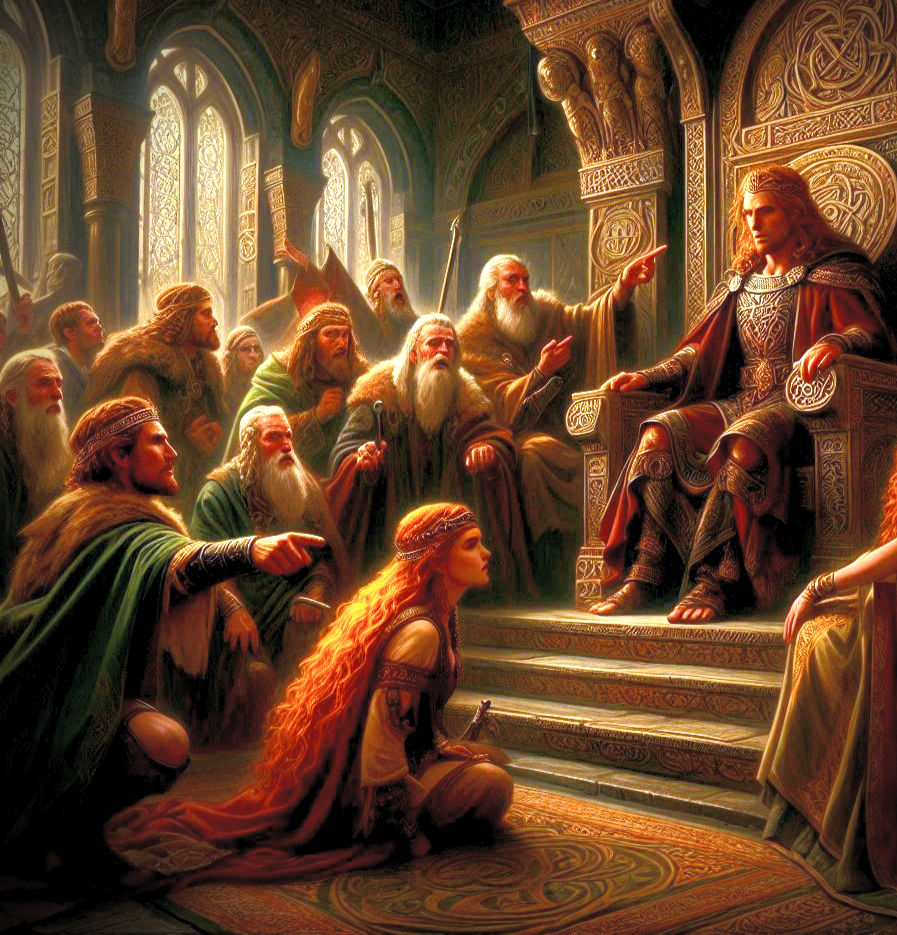
Many scholars say this moment in the text indicates that the myth-tellers associate Rhiannon with the Celtic goddess of horses, Epona. But I want the academics to get out of the way. Let’s look at this from a character and subtextual perspective. Rhiannon’s punishment—set by her husband—is to let strange men ride her like a horse?
Yes, this is an English translation of a text written in Middle Welsh. Nevertheless, the imagery is the same: a man mounting a woman and riding her. There is an undeniable and uncomfortable subtext.
Rhiannon’s Uncharacteristic Submission
Surprisingly, the quick-witted, ever-resourceful Rhiannon accepts this penance without complaint.
Of course, with all that has happened, she must be reeling emotionally and mentally. It’s understandable if she loses her aplomb in the moment. But once she’s had time to think, why does she go through with the penance? Daily. For years.
An ordinary woman might feel doing penance is better than being cast aside. Whether set in the medieval period or ancient Celtic Wales, a woman might have difficulty surviving on her own.
Rhiannon, however, is no ordinary woman. We know this. We’ve already met that self-sufficient goddess who “rules her life like a fine skylark.” So, why doesn’t she come up with a plan to get out of this abhorrent decree? Why doesn’t she fly into a rage at Pwyll for believing she would commit such a heinous act? If he believes she’s innocent, why doesn’t he defend her and grill those handmaids?
It seems time for Rhiannon to tell Pwyll, “I’ve called you a fool before, but you’re worse than a fool. Keep your penance! I’m leaving.”
But she doesn’t. Dutifully, each day, she carries out the penance. In the evening, Pwyll has her brought into the castle to dine with him as his queen.
Some scholars spin this as a morality lesson, saying Rhiannon is a model of humility and patience. But is there any plausible character motivation for doing the penance?
Possibly. Rhiannon might feel she deserves the punishment.
Rhiannon and the Abandoned Child

First, let me state Rhiannon did nothing wrong. She had a baby and, exhausted, fell asleep. The handmaids were supposed to be taking care of the infant.
Still, she is a mother. Something bad happened to her child, and she failed to protect him. Rhiannon may think If only I hadn’t fallen asleep, my baby would be here now, safe and sound. Her feelings of guilt may extend to Pwyll, too. She gave him a son, then lost him. Perhaps this is why she accepts without protest the penance he assigns.
Objectively, she is innocent. That doesn’t mean she feels guiltless.
What was Lost is Restored
Years pass. Then, one day, a horse lord comes to the castle. He has a young boy in tow. The horse lord relates how he rescued the boy from a monster. He and his wife raised the child until his striking resemblance to the king became apparent.
Pwyll and the courtiers accept that this is the missing heir to the throne. Rhiannon is exonerated. She names the boy Pryderi, which means “sadness” or “loss.” It’s an interesting choice. Is she thinking of the child’s loss of family and all he went through? Or is Pryderi now a symbol of her sadness and loss?
Later, she nearly loses him again. As a young man, Pryderi embarks on a quest with a group of friends. His companions return to court without him and report that the prince went into a dark tower but never came out. Rhiannon commands them to take her to the place. She hurries in to find her son. The tower is enveloped in a whirlwind and vanishes, along with her and Pryderi.
What Do You Think?
As you can see with the tower incident, Rhiannon has returned to her old take charge-self. So, what do you think? Does Rhiannon’s change of character mid-story stem from events in her life, or is it editor-imposed? Is there a character motivation other than guilt that might explain her acceptance of the penance? I look forward to your reaction and insights!
Thanks for reading! I hope you enjoyed this post and any of my others you check out. Please LIKE and SHARE. To SUBSCRIBE for FREE, just click on the “Sign Up” button in the upper right of the page.
All artwork for this post (except for the Ukrainian flag and the GIF) by Christine Dorman via Bing Image Creator.
Slán go fóill
Looking for a guide along your writing journey? Click here for a description of my writing and tutoring services. Questions? Just click here to contact me.


Comments